


-
Past ETC Papers
Browse, search and view papers from the past AET Conferences.

-
Members' Area
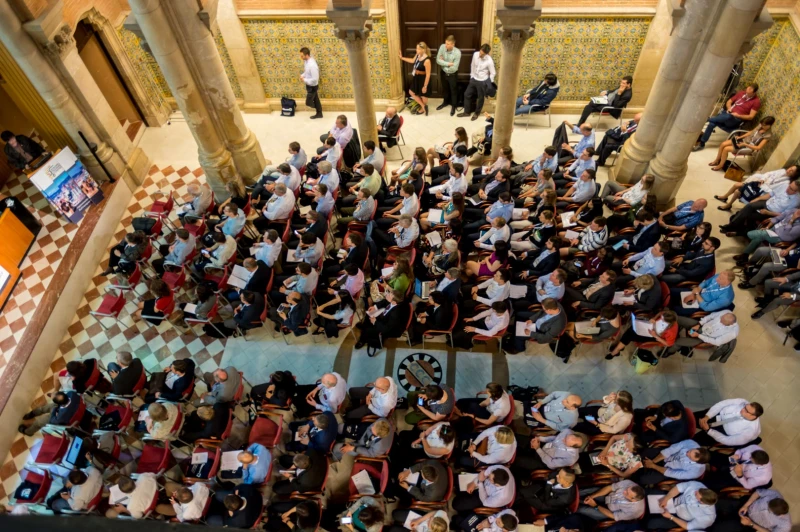
AET promotes networking and exchange of ideas, information and opportunities amongst members.
ETC Conference Papers 2021
Where are the Passengers? Individual Passenger Route Choice Estimation from Gate Information in Urban Rail Transit Systems
Seminar
Day 3 (15 Sep 2021), Session 7, COVID-19 AND THE CONSEQUENCES, 10:00 - 12:00
Status
Accepted, documents submitted
Submitted by / Abstract owner
Thomas James Tiam-Lee
Short abstract
We propose a novel statistical approach to infer passenger route choices in a rail network by temporally aligning card validation data at station gates with train schedules, thus supporting data-driven service allocation and safety norms compliance.
Abstract
Public urban rail transit is a major mode of transportation in many cities around the world. The latest report by the International Association of Public Transport estimates that metro systems had a total ridership globally of 53,768 million in 2017, with Asia-Pacific and Europe leading the numbers. The massive usage of urban rail transit underscores the importance of government efforts to ensure that metro systems are reliable, safe, and efficient for the public. One of the aspects to consider for operators is the effective resolution of bottlenecks in passenger traffic, which now has even more relevance in the context of the current COVID-19 pandemic to ensure the satisfaction of health safety norms.
One of the major challenges for metro network operators in dispersing bottlenecks is the variability of passenger route choices, which are not deterministic as it depends on the subjective perception of travel time, required transfers, convenience factors associated with possible transfers, and on-site train arrivals or waiting times. This makes it difficult to infer the volume of passengers along specific segments of the network at a given time and, consequently, to solve constrictions in passenger traffic. In this study, we focus on modelling individual passenger routes and the overall passenger flow in a rail network based only on data of passenger entries and exits in the system.
For this study, we use automated fare collection data from the Lisbon Metro rapid transit system. The data consists of all individual card validations at station entry and exit gates, containing the card number and the timestamp. On average, there are approximately 1 million card validations in the Lisbon metro daily for the said month. In this study, our goal is to use this data to statistically infer the passenger flow in the rail network, which includes not only the traffic in each station, but also the routes taken by the passengers within the network from entrance to exit throughout different times and days.
To accomplish this task, we propose a novel computational approach to infer individual passenger routes which assesses the likelihood of each possible route choice by aligning card validation timestamps against real-time route scheduling. In the absence of vehicle geolocation data, the location of the trains at different times can be estimated by analyzing passenger volume peaks at the exit station gates. We can then use this information, along with an analysis of the trip durations, to better infer the likelihood that a passenger took a specific route based on the timings of his or her entry and exit from the metro.
The results of this study are valuable to administrators and policymakers aiming to improve the services of the urban transit system. It can be used to identify bottlenecks in the passenger flow, as well as understand trends in passenger intentions and behavior over time. This is helpful in various aspects of decision-making such as the allocation of resources like trains and other services, and the discovery and understanding of popular routes to aid in introducing new policies and interventions such as making use of express trains that do not stop at every station, or nudging people to encourage them to take a more favorable route. It can also be used to create intuitive visualizations to support decision-making.
Furthermore, the model we propose offers two main advantages. First, it requires minimal information that is easily obtainable in most urban rail transit systems. This allows it to be implemented easily without the use of complex and privacy-invasive sensors and monitoring devices. Second, it is adaptable to changes in the network not only because of unforeseen events like malfunctions and delays, but also changes in operational schedules and policies. This means that the model is robust and can remain reliable over time.
In this paper, we provide a background of the research and related studies, followed by a formalization of the problem. We then describe our approach for inferring passenger routes and passenger flow, and validate it using data collected from the Lisbon metro. Finally, we discuss the resulting model and the insights that could be generated from it, and how these insights could be helpful for decision-making in the context of public rail transport.
Programme committee
Data
Topic
COVID-19 and the Consequences
Documents:

Conference Supporters & Endorsers


